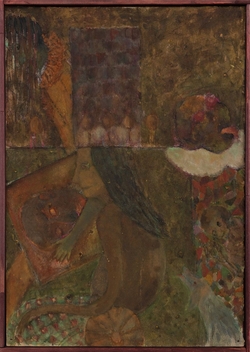
From the "Swamps" series
| Artists | |
|---|---|
| Year | 2025 |
| Material | Oil on canvas |
| Size | 100 × 100 см |
Peter Shvetsov presents a project exploring the boundaries of painting using the example of one seemingly simple motif – a landscape with a swamp. The picturesque texture is tested here for its ability to convey the depth of a submerged quagmire, in which gaze and meaning become entangled. The initial impetus for the work was given by V. N. Sukachev's popular science book "Swamps, their formation, development and properties", published in Leningrad in 1926. It describes the causes and forms of deformation of acidic swampy soil, provides classifications of marshes by type and species, and examines swamp flora and fauna. Material experimentation with semantic layers is characteristic of Peter Shvetsov's work in general. In the Swamps project, painting comes to the fore, the canvas takes over all the complexity, and for the first time the strategies of meaning generation are regulated almost exclusively by the behavior of the picturesque masses...
The Marshes project documents the gradual unfolding of the canvas format behind alkalis, mud, fats, soils and varnishes; the consistent purification of painting from the tangibility of sculpture and object; the evolution from material to image. That is why "Marshes" is not a painting series in the strict sense of the word, but a range of works united by one theme, the initial desire to peer as closely as possible into the etymological essence of the swamp, into its picturesque depth.
Each new work is chemically and visually different from the previous one, and stands one step further in the research perspective. The choice of a genre motif determined the evolution of the style, but the severity of the chosen colors initially resisted the parlorism and self-love inherent in the landscape genre as a whole. From the dry black theatricality, which goes back to the manner of the German "new wild", the study developed towards images of a red swamp forest in the spirit of the experiments of early Mondrian and the disturbing visions of Munch, and finally resulted in a calm coniferous channel of the landscape classics of the Russian Wanderers. Peering into the swamp turned into a backward movement, towards the art of the 19th century, during which the screaming animal horror of the pool went inside the traditional canvases, locked into them, hidden by anxious tension. The landscape genre, dissected in the creative laboratory, turned into a harsh, straightforward painting without inscriptions and quotes, without the ambiguities of the "message" and reciprocal interactivity, without the games of the signifier and the signified.
Text: Dmitry Ozerkov